










Nizhnevartovsk, Russian Federation
Nizhnevartovsk, Russian Federation
Nizhnevartovsk, Russian Federation
UDC 581.9
UDC 581.524.4
CSCSTI 34.35
Russian Classification of Professions by Education 05.03.06
Russian Library and Bibliographic Classification 2
Russian Library and Bibliographic Classification 280
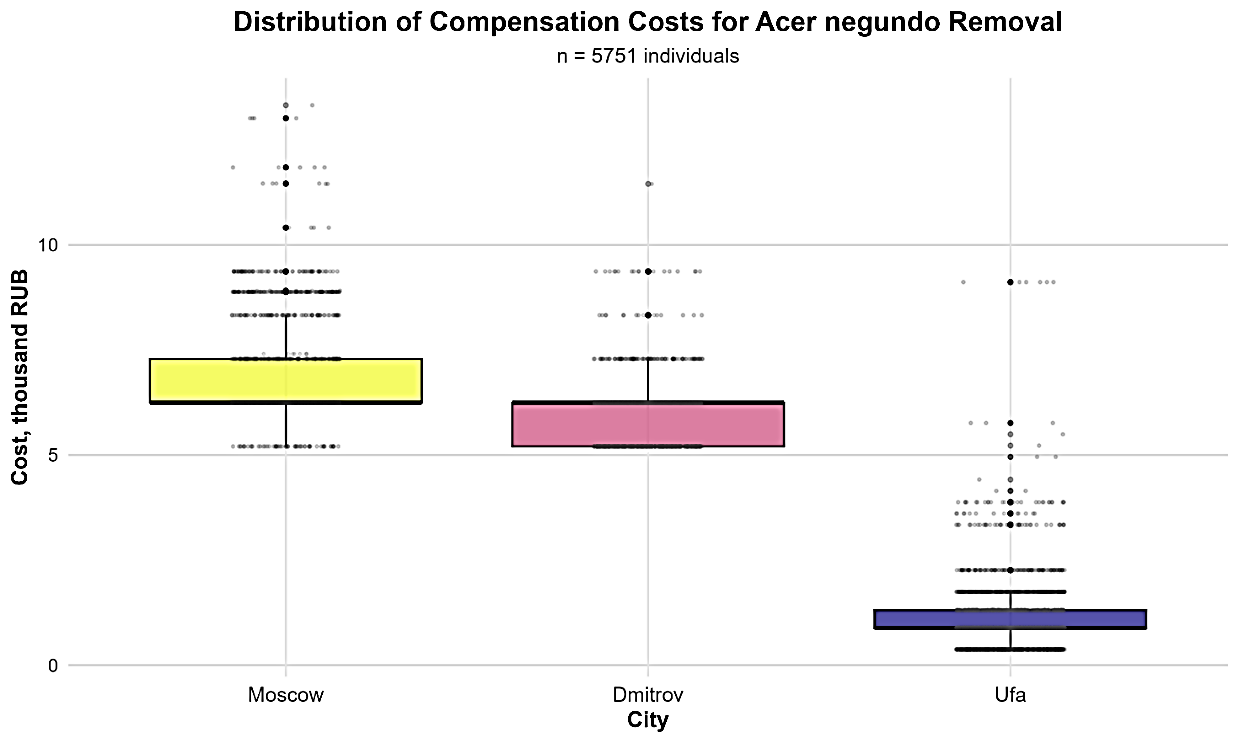
Based on tree level data from engineering environmental surveys at 9 construction sites in four Russian cities (Ufa, Dmitrov, Moscow, Birobidzhan), the distribution of invasive woody plant species was analyzed. A total of 27,418 trees of 57 species were recorded. The proportion of invasive species ranged from 0 % in Birobidzhan to 46.8 % in Moscow. The absolute dominant among invasives is Acer negundo L. (5,751 individuals, 21 % of all trees). Regression analysis of the log transformed compensation cost (calculated according to regional regulatory documents) showed that, all else being equal (diameter, height, condition, city), invasive trees have, on average, a 9.9 % lower cost (p < 0.001), which is explained by the reduced species coefficients for box elder maple already embedded in the existing valuation methods. However, this reduction is insufficient to cover the costs of subsequent invasion control and monitoring. For A. negundo L., significant inter city differences were found: the highest proportion (9.9 % of all trees) and the lowest average cost (1,106 RUB) were recorded in Ufa, due to a high number of small diameter individuals on disturbed lands. In Moscow and Dmitrov, despite lower proportions, the average cost of invasive trees is much higher (6,836 and 6,085 RUB, respectively) due to larger tree sizes and better condition. Invasive herbaceous species (Heracleum sosnowskyi Manden., Solidago canadensis L., Ambrosia artemisiifolia L., etc.) were also recorded at the survey sites, requiring special attention during post project monitoring. We propose changes to the regulatory framework: introduction of an additional reduction factor (0.1–0.3) for invasive species when calculating compensation costs, mandatory inclusion of post project monitoring (at least 5 years) with removal of invasive seedlings, and priority use of native fast growing species in compensatory plantings on reclaimed sites.
invasive species, Acer negundo, urban ecosystems, engineering and environmental surveys, compensation cost, urban forest management
1. Decision of the Council of the City District of Ufa of the Republic of Bashkortostan No. 23/19 of 26.02.2010 “On the Rules for the Protection, Protection and Reproduction of Forests and the Maintenance of Green Spaces in the City District of Ufa of the Republic of Bashkortostan and the Regulation on the Procedure for Assessing and Compensating for Damage Caused to Forests and the Green Fund in the City District of Ufa of the Republic of Bashkortostan” (as amended on 01.10.2025). (in Russ.).
2. Gaertner, M., Holmes, P.M., & Richardson, D.M. (2016). Managing invasive species in cities: A framework from Cape Town. Landscape and Urban Planning, 151, 1-9. https://doi.org/10.1016/j.landurbplan.2016.03.010
3. Golovanov, Ya.M., & Abramova, L.M. (2022). Nakhodki invazionnykh vidov rasteniy na yugo-vostoke Orenburgskoy oblasti. Soobshchenie 3. Vestnik Orenburgskogo gosudarstvennogo pedagogicheskogo universiteta, (1), 1-10. (in Russ.). https://doi.org/10.32516/2303-9922.2022.41.1
4. Ishbirdina, L.M., & Ishbirdin, A.R. (1991). Sinantropnye drevesnye soobshchestva g. Ufy. (in Russ.). Botanicheskiy zhurnal, 76(4), 548-555.
5. Khorun, L.V., & Martynyuk, Yu.M. (2016). Proektirovanie regional'noy monitoringovoy seti dlya kontrolya za vnedreniem i rasseleniem invazionnykh vidov rasteniy. Izvestiya Tul'skogo gosudarstvennogo universiteta. Estestvennye nauki, (1). Retrieved from https://clck.ru/3UDfYv (accessed 30.03.2026). (in Russ.)
6. Krasnaya kniga Respubliki Bashkortostan. (2021). Vol. 1: Plants and Fungi. Ed. by V.B. Martynenko. 3rd ed. Moscow: Studiya onlayn. 392 p. (in Russ.)
7. Mayorov, S.R., Vinogradova, Yu.K., & Kuklina, A.G. (2023). Invazionnye rasteniya v gorodskikh ekosistemakh: sovremennoe sostoyanie i perspektivy izucheniya. Botanicheskiy zhurnal, 108(5), 412-428. (in Russ.)
8. Metodika rascheta platy za vyrubku zelenykh nasazhdeniy i ischisleniya razmera vreda, prichinennogo ikh unichtozheniem, povrezhdeniem, na territorii munitsipal'nykh obrazovaniy Moskovskoy oblasti [Methodology for Calculating the Fee for Cutting Down Green Spaces and Determining the Amount of Damage Caused by Their Destruction or Damage in the Municipalities of Moscow Region]. Approved by Protocol No. 53 of the Commission for Administrative Reform in Moscow Region on 29.01.2018. (in Russ.)
9. Mirkin, B.M., & Naumova, L.G. (2012). Nauka o rastitel'nosti [The Science of Vegetation]. Ufa: Gilem. 488 p. (in Russ.)
10. Nikolaeva, A., Golosova, E., & Shelepova, O. (2020). Methods of combating A. negundo L.in specially protected natural areas. BIO Web of Conferences, 24, 00063. https://doi.org/10.1051/bioconf/20202400063
11. Richardson, D.M., & Rejmánek, M. (2011). Trees and shrubs as invasive alien species – a global review. Diversity and Distributions. Vol. 17. P. 788-809. DOI: https://doi.org/10.1111/j.1472-4642.2011.00782.x
12. Senator, S.A., Kuznetsov, V.A., Zaika, M.A., et al. (2023). Invasive Plants of Russia: Inventory Results, Distribution Patterns and Management Priorities. Biology, 12(3), 387. https://doi.org/10.3390/biology12030387
13. Veselkin, D.V., Kiseleva, O.A., Ekshibarov, E.D., Dubrovin, D.I., & Korzhinevskaya, A.A. (2018). Bogatstvo i chislennost' prorostkov iz pochvennogo banka semyan v kurtinakh invazionnogo vida A. negundo L. Rossiyskiy zhurnal biologicheskikh invaziy, 11(1), 18-25. (in Russ.)
14. Veselkin, D.V., Kiseleva, O.A., Ekshibarov, E.D., Dubrovnyi, D.I., & Korzhinevskaya, A.A. (2021). High canopy cover of invasive A. negundo L.affects ground vegetation diversity in urban forests. Scientific Reports, 11, 21785. https://doi.org/10.1038/s41598-021-01363-5
15. Vinogradova, Yu.K., Mayorov, S.R., & Kostina, M.V. (2022). Klen yasenelistnyy (A. negundo L.): morfologiya, biologiya i otsenka invazivnosti. Moscow: KMK Scientific Press. 218 p. (in Russ.)
16. Vinogradova, Yu.K., Mayorov, S.R., & Khorun, L.V. (2010). Chernaya kniga flory Sredney Rossii. Moscow: GEOS. 512 p. (in Russ.)