










Kemerovo, Russian Federation
Kemerovo, Russian Federation
Kemerovo, Russian Federation
UDC 615.322
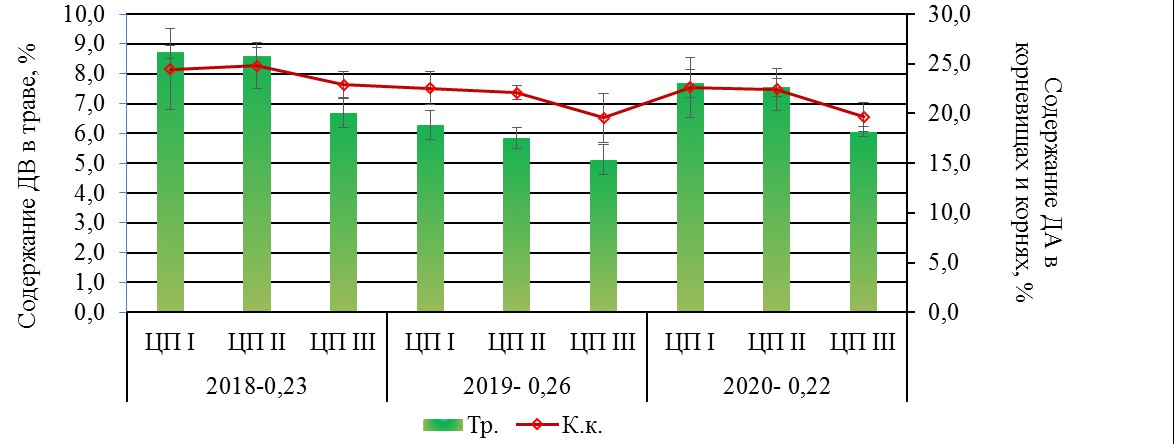
For the great burnet (Sanguisorba officinalis L.) raw material rational harvesting, as well as ensuring its comprehensive, waste-free utilization, it is necessary to assess the influence of growing locations, age, vegetation phase, climatic, and soil conditions on the tannins accumulation in its above-ground and underground organs. The research was conducted during the period 2018–2020. Raw material harvesting was carried out in three natural cenopopulations (CP): CP I – floodplain grass-herbaceous meadow, CP II – dryland herbaceous meadow, CP III – birch forest, during different vegetation periods. The tannin content in the raw material was determined by permanganatometric titration in accordance with the requirements of the XV edition State Pharmacopoeia. It was found that in the herb maximum tannins amount accumulates during the flowering phase (6.096–9.323 %) and the minimum during the fruiting period (4.049–7.998 %). Rhizomes and roots are characterized by the presence of two accumulation maxima: at the beginning of vegetation (19.194–24.698 %) and during the flowering period (21.310–26.595 %). The tannin content in the fruiting phase decreases in underground organs by an average of 1.3 times, and in the above-ground organs – by 1.2 times. The studies showed that the moisture level and light availability, soil factors (high content of humus, phosphorus, potassium) contribute to greater tannin accumulation. Its highest content was observed in the above-ground and underground organs of burnet in CP I and CP II. The calculated extremality hydrothermal coefficient (Kextr.) ranged from 0.22 to 0.26 in the study years. The highest Kextr. was obtained for 2019 (0.26), which showed the lowest tannin content. The tannin accumulation patterns obtained data in the great burnet above-ground and underground organs have a practical importance for the pharmaceutical industry.
tannins, quantitative determination, Sanguisorba officinalis L., medicinal plant raw materials, habitats, Kemerovo Region − Kuzbass
1. Anczupova, T.P., & Mazur L.V. (2015). E`kologo–cenoticheskaya i fitoximicheskaya xarakteristika Kakalii kop`evidnoj Zapadnogo Zabajkal`ya. Vestnik Buryatskogo gosudarstvennogo universiteta. Biologiya, Geografiya. (in Russ.).
2. Brezgun, N.N. (1993). Lekarstvenny`e rasteniya central`noj chasti Rossii. M.: Slog (in Russ.).
3. Chen, J. F., Tan, L., Ju, F., Kuang, Q.X., Yang, T.L., Deng, F., Gu, Y.C., Jiang, L.S., Deng, Y., & Guo, D. (2022). Phenolic glycosides from Sanguisorba officinalis and their anti-inflammatory effects. Nat Prod Res, 36(8), 2097-2104. https://doi.org/10.1080/14786419.2020.1849202
4. Egorova, N.O. (2019). Soderzhanie dubil`ny`x veshhestv v nadzemny`x i podzemny`x chastyax Sanguisorba officinalis L. iz flory` Kemerovskoj oblasti. Sbornik: Razvitie – 2019. Nauchnoe e`lektronnoe izdanie. (ss. 231-238). Kemerovo. (in Russ.)
5. Egorova, N.O. (2021). Ocenka soderzhaniya dubil`ny`x veshhestv v sy`r`e Sanguisorba officinalis L, proizrastayushhej na territorii Kemerovskoj oblasti. Sbornik: Razvitie – 2021. Nauchnoe e`lektronnoe izdanie. (ss. 210-218). Kemerovo. (in Russ.).
6. Gammerman, A.F., & Grom, I. I. (1976). Dikorastushhie lekarstvenny`e rasteniya SSSR. M.: Medicina (in Russ.).
7. Gawron-Gzella, A. (2016). Chemical Composition, Antioxidant and Antimicrobial Activities of Sanguisorba officinalis L. Extracts. Pharmaceutical Chemistry Journal, 4, 244-249. https://doi.org/10.1007/s11094-016-1431-0
8. Ikonnikova, I.A. (2016). Issledovanie soderzhaniya dubil`ny`x veshhestv i vy`razhennosti antioksidantnoj aktivnosti v kornevishhax i kornyax krovoxlebki lekarstvennoj (Sanguisorba officinalis L.), zagotovlenny`x v razlichny`x rajonax Orenburgskoj oblasti. Science Time. (4 ,28), 347-353. (in Russ.).
9. Kazeeva, A.R., & Pupy`kina K.A. (2015). Izuchenie soderzhaniya osnovnoj gruppy` biologicheski aktivny`x veshhestv v krovoxlebke lekarstvennoj v razny`e fazy` vegetacii rasteniya. Tradicionnaya medicina, (2, 41), 37-38. (in Russ.).
10. Kazeeva, A.R., Pupy`kina, K.A, Denisova, S.G., Shajdullina, G.G., & Reut, A.A. (2019). Fitoximicheskoe issledovanie travy` Sanguisorba officinalis L. v respublike Bashkortostan. Ximiya rastitel`nogo sy`r`ya, (4), 279-84. (in Russ.). https://doi.org/10.14258/jcprm.2019045371
11. Kireeva, T.B., & Titova, E.A. (2006). E`kologicheskie i ontogeneticheskie osobennosti nakopleniya dubil`ny`x veshhestv v trave dushicy oby`knovennoj v usloviyax Udmurtii. Biologiya, (10), 85-96. (in Russ.).
12. Minaeva, V.G. (1997). Lekarstvenny`e rasteniya Sibiri. Novosibirsk: Nauka (in Russ.).
13. Muxametgaliev, N.R., Idrisova, G. I., & Gilazieva, G. Z. (2015). Sravnitel`ny`j analiz soderzhaniya dubil`ny`x veshhestv v kornevishhax krovoxlebki lekarstvennoj (Sanguisorba officinalis L.). Ucheny`e zapiski Kazanskogo universiteta. Kn.2. Estestvenny`e nauki, (157), 58-68. (in Russ.).
14. Nosov, A.M. (2004). Lekarstvenny`e rasteniya. M.: E`ksmo (in Russ.).
15. Prosyannikova, O.I. (2007) Pochvenno-agroximicheskoe rajonirovanie i primenenie udobrenij v Kemerovskoj oblasti. Kemerovo: Kuzbassvuzizdat (in Russ.).
16. Rabotnov, T.A. (1984). Lugovedenie, Uchebnik – 2-e izd. M. Izd-vo MGU (in Russ.).
17. Samojlov, V.I., Fedorov, S.V., & Petrovskaya, N.V. (2012). Vliyanie faktorov okruzhayushhej sredy` na nakoplenie biologicheski aktivny`x veshhestv v lekarstvenny`x rasteniyax. Fiziologiya rastenij, (59, 4), 623-630. (in Russ.).
18. Saparkly`cheva, S.E., & Chapalda, T.L. (2020). Antimikrobnaya aktivnost` krovoxlebki lekarstvennoj (Sanguisorba officinalis L.). Agrarnoe obrazovanie i nauka, (2), 10. (in Russ.).
19. Scalbert, A., Johnson, I.T., & Saltmarsh, M. (2005). Polyphenols: antioxidants and beyond. The American Journal of Clinical Nutrition, 81(1), 215S-217S. https://doi.org/10.1093/ajcn/81.1.215S
20. Sery`x, G.I. (1983). Krovoxlebka lekarstvennaya – Sanguisorba officinalis L. Atlas arealov i resursov lekarstvenny`x rastenij SSSR. M.: Kartografiya (in Russ.).
21. Soboleva, L. S., & Kry`lova I.L. (1990). Zelenaya apteka Tatarii. Kazan`: Tatarskoe knizhnoe izdatel`stvo. (in Russ.).
22. Telyat`ev, V. V. (1997). Polezny`e rasteniya Central`noj Sibiri. Irkutsk: Vost-Sib. knizh. izd-vo. (in Russ.).
23. Xalilova, R.S., & Karomatov I.D.(2021). Krovoxlebka lekarstvennaya, al`pijskaya. Biologiya i integrativnaya medicina. (3,50), 153-173. (in Russ.).
24. Xozyainova, N.V. (1989). Morfologo-biologicheskie osobennosti Sanguisorba officinalis: special`nost` 03.00.05 «Botanika»: avtoreferat dissertacii na soiskanie uchenoj stepeni kandidata biologicheskix nauk. Moskva (in Russ.).
25. Zaprometov, M.N. (1994). Fenol`ny`e soedineniya: rasprostranenie, metabolizm i funkcii v rasteniyax. M. (in Russ.).
26. Zaynab, M., Fatima, M., Abbas, S., Sharif, Y., Umair, M., Zafar, M.H., & Bahadar, K. (2018). Role of secondary metabolites in plant defense against pathogens. Microb Pathog, 124, 198-202. https://doi.org/10.1016/j.micpath.2018.08.034
27. Zemlinskij, S.E. (1958). Lekarstvenny`e rasteniya SSSR. M.: Medgiz (in Russ.).
28. Zheng, Y., Lee, S. Y., Lee, Y., Lee, T.K., Kim, J.E., Kim, T.H., & Kang, I.J. (2023). Standardized Sanguisorba officinalis L. Extract Inhibits Adipogenesis and Promotes Thermogenesis via Reducing Oxidative Stress. Antioxidants (Basel), 12(4), 882. https://doi.org/10.3390/antiox12040882
29. Zy`kova, I.D. (2015). Izmenenie sostava e`firnogo masla volodushki kozelecelistnoj (Bupleurum scorzonerifolium L.), proizrastayushhej v Sibirskom regione, v zavisimosti ot meteorologicheskix uslovij. Vestnik Krasnoyarskogo gosudarstvennogo agrarnogo universiteta, (7.), 33-38. (in Russ.).